


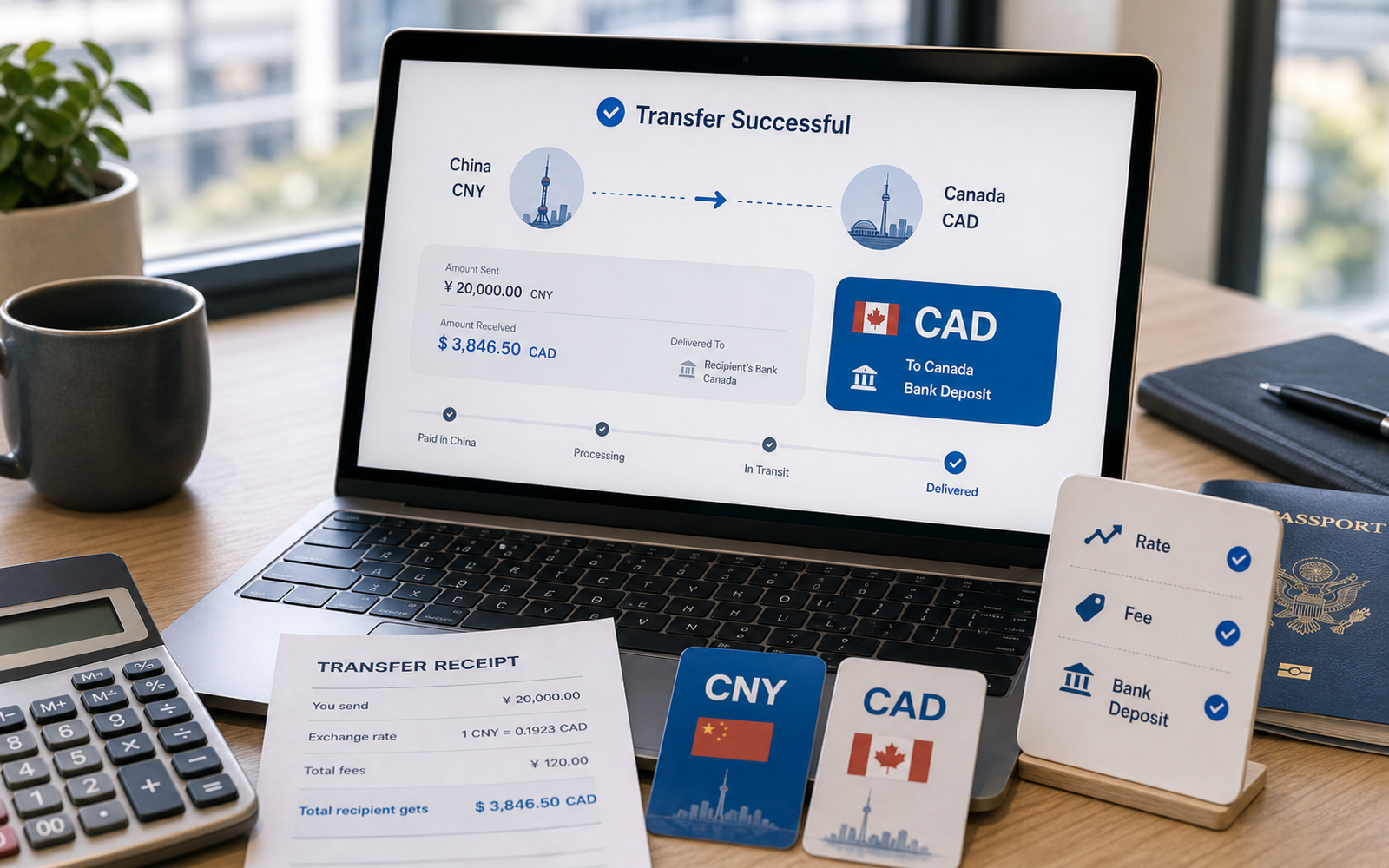
Best Way to Send Money from China to Canada
SkyRemit Guide
Best Way to Send Money from China to Canada
A practical guide for eligible expats and foreign workers in China, focused on documented salary remittance, review readiness, and choosing the right route before sending.
Short answer
For most eligible expats in China sending after-tax salary to Canada, the best way is usually a regulated transfer platform rather than a traditional bank wire. The main reasons are clearer final payout, faster supported timing in standard cases, and less friction when Canadian bank details need to be entered carefully.
In practice, the answer is not just app versus bank. It is whether a cleaner digital route helps you avoid common Canada detail-entry mistakes and whether that route gives you a better final payout with fewer correction problems.
Quick Answer
- For a standard salary-remittance case, a regulated transfer platform is usually the most practical option.
- For Canada transfers, recipient-bank details matter more than many users expect, because format mistakes can fail the transfer even when the banking information itself is real.
- The strongest choice usually comes from checking fit in the right order: salary-remittance fit first, Canada corridor support second, and final payout plus support third.
Quick Comparison
| Option | Process | Typical timing | Cost logic | Documents | Experience |
| Structured platform | Digital salary-remittance flow for supported Canada payouts | Fastest 10 hours in supported Canada cases | Usually easier to compare final payout before sending | Passport, work-status documents, and tax-related salary support | More digital, easier to repeat, and easier to manage if recipient details need checking |
| Traditional bank | Branch-led international wire transfer | Often around 2-3 business days, depending on bank and intermediary handling | Often includes wire-style charges and a less predictable final payout | Usually the same core salary-remittance documents, but with more counter handling | More manual and more time-consuming if recipient fields or documents need correction |
Why Canada Account Details Change the Answer
Canada transfers often fail for a simple reason, the recipient details are entered in the wrong structure. That can happen even when the sender has the right banking information in front of them.
Canadian accounts do not all use one fixed account-number format. Many banks use account numbers in the 7-12 digit range, and the transit number, institution number, and account number often belong in separate fields. If a form asks for a shorter account number and the sender enters a longer string that combines other numbers, the transfer can fail.
That is one reason many expats choose a platform for Canada. It is easier to manage a transfer when the form makes Canadian bank fields clearer before the money is released.
If you are still deciding at the mechanism level first, compare bank wire vs transfer platform in China before narrowing the answer to the Canada corridor.
Why a Platform Often Feels Easier Than a Bank for Canada Transfers
Both routes still involve review. The practical difference is that a standard salary-remittance case is often easier to manage in a stronger digital flow, especially when the sender needs to double-check recipient fields before release.
In a bank-led wire process, a wrong field can mean more back-and-forth with the branch, more manual correction, and a slower retry. Many expats find a digital route easier to repeat once the first successful Canada transfer has been established.
Why Final Amount Still Matters More Than Headline Fee
For a structured platform, the quote is usually easier to understand before sending. For a bank wire, the sender often has to think beyond the visible branch fee because final payout can still be reduced by weaker FX and intermediary-bank deductions.
That is why a China-to-Canada transfer should be judged on final amount received, not just on the exchange rate shown on screen or the first fee number mentioned at the counter. If you want the broader cost logic first, read the cheapest way to send money from China overseas. If you want a direct brand comparison, see SkyRemit vs Wise for expats in China.
Documents Are Similar, But the Bank Process Often Feels Heavier
For a standard salary remittance from China to Canada, the core document set is usually passport, a valid work-status document, and tax-related salary proof. In simpler terms, the normal requirement is identity plus lawful taxed-income support.
In some review cases, additional income support may also be accepted, such as IIT app screenshots, an employment contract, payslips, employer proof, or bank statements. If you want the full checklist first, see what documents foreigners need to send money from China.
The practical difference is not that banks need documents and platforms do not. The difference is that bank handling often feels more repetitive, while a stronger digital process makes later transfers easier once the first case has been established.
How Long Does It Usually Take?
For supported Canada cases, timing is usually within 1 business day after release. Traditional banks more often land around 2-3 business days, depending on bank handling and intermediary processing.
The first transfer can still take longer because documents and review happen for the first time. That review time is different from payout time. Once the transfer is released, actual arrival still depends on route, the receiving bank in Canada, timezone timing, and bank holidays.
Important Canada Account Details
- Canadian account numbers are not all the same length. Many banks use 7-12 digits depending on the bank.
- Transit number, institution number, and account number should go into the correct separate fields. Do not merge them unless the form explicitly asks for a combined format.
- If your bank gives you a cheque or app view, copy the details exactly from there instead of rebuilding the number yourself.
- If the form asks for a shorter account number, do not enter a longer string that also contains the transit number.
- If a SWIFT code is required, confirm it in the bank app, online banking, or official bank site rather than guessing.
Typical Transfer Amount Range
On SkyRemit, the single-transfer amount is commonly shown within a 500–300,000 RMB range, although the supported amount still depends on the strength of tax and income documents. Stronger tax records usually make the supported amount easier to assess.
When a Bank May Still Be the Better Fit
- You prefer branch-led handling and do not mind in-person processing.
- Your case is less standard and feels safer inside a bank workflow.
- You are comfortable spending more time on bank-side document handling if needed.
When a Structured Platform May Be a Strong Fit
- You are an eligible expat in China sending after-tax salary to Canada.
- The Canada corridor is well supported for your case.
- You want a clearer digital process rather than a branch-led wire flow.
- You care more about final amount received than exchange rate alone.
- You want fewer delays caused by recipient-detail mistakes and easier support if something needs checking.
Compare With a Smaller First Transfer
If SkyRemit fits your salary-remittance case, a smaller first transfer can help you compare the actual recipient amount, fee, exchange rate, funding steps, and arrival experience under real conditions. New SkyRemit users can claim a 100 RMB trial credit and use the code TRY100 during registration.
Claim the trial credit and register
The trial credit is intended for first-time experience. Availability, eligibility, validity period, and detailed use rules are subject to the registration page and SkyRemit's current terms.
FAQ
What is usually the best way to send money from China to Canada?
For most eligible expats sending after-tax salary, a regulated transfer platform is usually the most practical option when the Canada corridor is well supported and the sender wants a clearer, easier-to-repeat process.
Why do Canada transfers fail even when the bank details look correct?
Because the issue is often not the bank itself, but how the details are entered. Transit number, institution number, and account number may need to go into different fields, and using the wrong format can fail the transfer.
What recipient details do I usually need for Canada?
Usually the account number, transit number, institution number, and in some cases a SWIFT code. The exact field layout depends on the receiving bank and the transfer form, so it is best to copy the details directly from the bank's own records.
How fast is China-to-Canada remittance usually?
For supported Canada cases, it is usually within 1 business day after release. Traditional bank wires are more often around 2-3 business days, depending on bank and intermediary handling.
Are the documents different for a Canada transfer?
Usually not in principle. For standard salary remittance, the core set is usually passport, valid work-status documents, and tax-related salary proof.
Related Guides
If you want the broader decision page, see which bank or money transfer platform is best for foreigners in China. If you want the direct route comparison, see bank wire vs transfer platform in China. If you want the salary-remittance process first, see how foreign workers send salary home from China. If you are comparing speed and cost, see the fastest way to send money from China and the cheapest way to send money from China overseas. If you are sending to another destination instead, see best way to send money from China to the US and best way to send money from China to the UK.
The Bottom Line
For most eligible expats in China, the best way to send money to Canada is usually the route that combines salary-remittance fit, cleaner recipient-detail handling, and a clearer final payout than a traditional wire. In many standard cases, that makes a regulated transfer platform the better answer.