


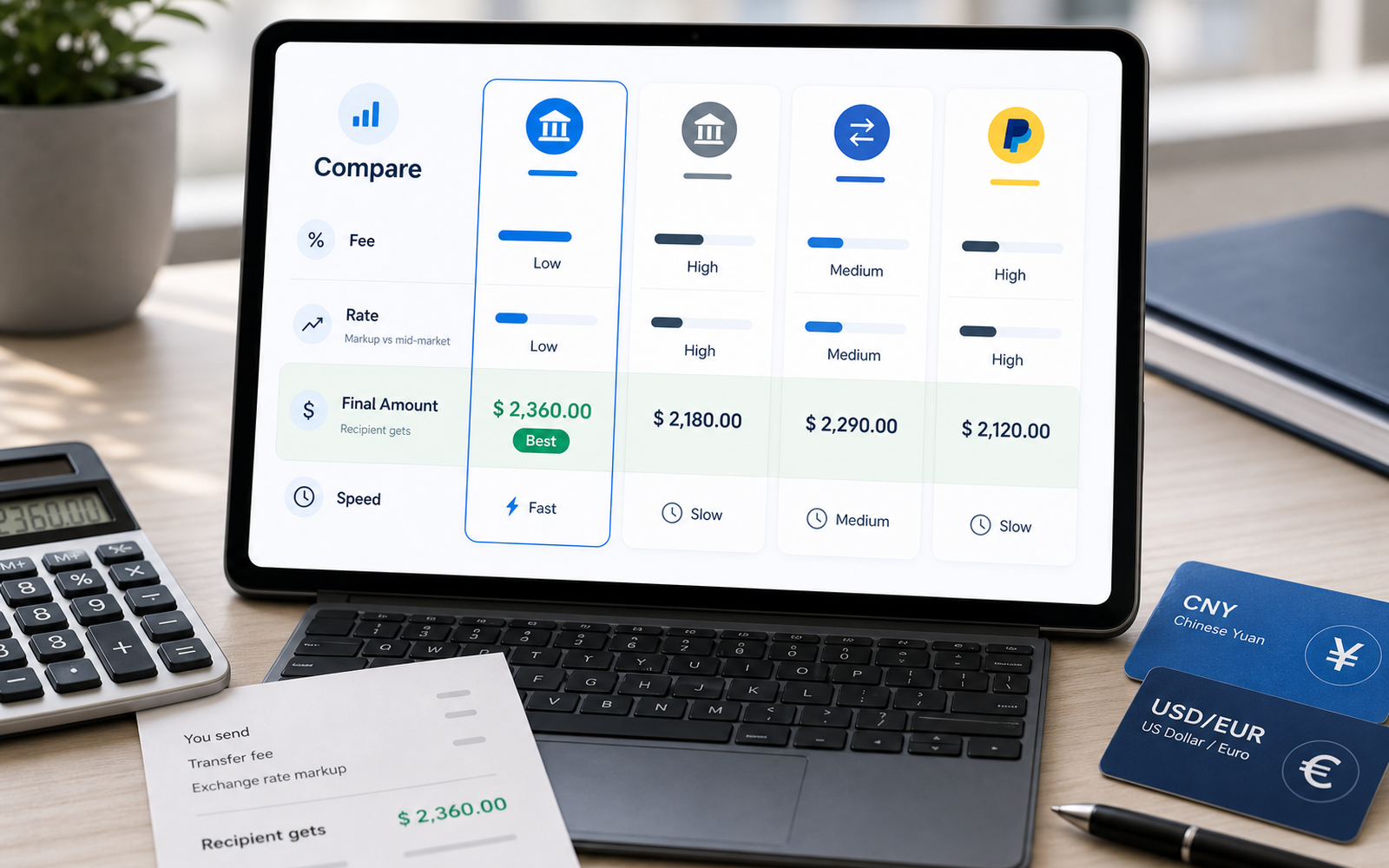
Final Amount Received: How to Compare SkyRemit, Banks, Wise, and PayPal
SkyRemit Guide
Final Amount Received: How to Compare SkyRemit, Banks, Wise, and PayPal
A practical guide for eligible expats and foreign workers in China, focused on documented salary remittance, review readiness, and choosing the right route before sending.
Short answer
When sending money from China, the lowest visible fee does not always produce the strongest payout. The better comparison is the final amount the recipient receives after service fee, exchange-rate markup, funding or channel cost, possible intermediary-bank deductions, and receiving-bank charges. This is especially important for eligible foreign workers sending documented RMB salary home.
SkyRemit, banks, Wise, PayPal, and other providers can show costs in different ways. A fair comparison uses the same send amount, same destination currency, same quote time, and the same recipient route. If one quote is from today and another is from tomorrow, exchange-rate movement can make the comparison misleading.
The Four Numbers to Compare
- Service fee or platform fee.
- Exchange-rate markup or spread.
- Funding or payment-channel fee where applicable.
- Receiving-bank, intermediary-bank, or wire-related deductions.
Quick Comparison Framework
SkyRemit
What to compare
79 RMB fixed fee, visible FX markup, funding method, payout route.
Where users can misread cost
Do not treat the fixed fee as the entire final cost in every route.
Traditional bank wire
What to compare
Bank service fee, cable fee, FX spread, intermediary-bank deductions, branch time.
Where users can misread cost
The printed bank fee may not include downstream deductions.
Wise or other transfer apps
What to compare
Percentage fee, FX quote, supported route, identity setup, funding method.
Where users can misread cost
A good global quote does not always mean the China outbound case fits.
PayPal or wallet-style routes
What to compare
Availability, wallet fees, withdrawal cost, FX spread, recipient access.
Where users can misread cost
Convenience can hide conversion and withdrawal costs.
SkyRemit Cost Structure
SkyRemit uses a 79 RMB fixed fee as the core pricing anchor. The final rate is based on XE real-time rates with a visible markup, and the markup can vary by currency. Alipay or WeChat Pay may add a channel fee in some cases, while bank transfer may not. Some wire-related routes may still involve intermediary-bank conditions.
For standard salary-remittance users, this makes SkyRemit worth comparing on final recipient amount rather than headline fee alone. The key question is how much the recipient is expected to receive after all visible and route-dependent costs are considered.
Bank Wires
A traditional bank wire may work well for some users, especially larger or more complex cases where in-person bank handling is preferred. The cost can include a bank service fee, exchange-rate spread, cable or wire fee, intermediary-bank deductions, and receiving-bank charges.
The time cost also matters. If the user needs to visit a branch, bring documents, wait for review, and repeat the same explanation later, the practical cost is higher than the printed fee alone.
Wise, PayPal, and Other Apps
Wise and PayPal may be familiar names for international money movement, but users should first check whether the exact China outbound route, identity setup, funding method, currency, and recipient country fit their case. A provider that works well in one country pair may not be the best fit for a documented RMB salary-remittance case from China.
For any provider, compare the final recipient amount at the same time. Do not compare one provider's fee, another provider's exchange rate, and a third provider's arrival estimate as if they were one complete quote.
How to Compare Fairly
- Choose the same send amount and recipient currency.
- Get quotes at the same time.
- Record the fee, FX rate, expected recipient amount, and any channel fee.
- Ask whether intermediary or receiving-bank deductions may apply.
- Check whether the route supports your identity, documents, and destination.
- Compare final amount received, not only headline fee.
A Simple Same-Time Quote Example
Assume you want to send the same RMB amount to the same recipient currency. A fair comparison would collect a SkyRemit quote, a bank wire estimate, and any Wise or PayPal quote at the same time. Then compare the expected recipient amount, not just the visible fee. If SkyRemit shows a 79 RMB fee but another route has a weaker exchange rate or possible downstream deduction, the final result may differ from what the fee line suggests.
The same logic can also work in the other direction. A provider with a higher visible fee may still be competitive if the exchange rate is stronger, the route avoids downstream deductions, or the recipient receives funds more predictably. The point is not to assume one brand wins every case. The point is to compare the complete route under the same conditions.
Route Fit Comes Before Price
Cost comparison only matters after the route fits the user's case. For China outbound salary remittance, the user still needs identity, work-status, source-of-funds support, and a destination route that can handle the payout. If a provider cannot support the user's China outbound case, a lower quote is not useful. The better order is: first check eligibility and route support, then compare final recipient amount.
Compare With a Smaller First Transfer
If SkyRemit fits your salary-remittance case, a smaller first transfer can help you compare the actual recipient amount, fee, exchange rate, and funding experience under real conditions. New SkyRemit users can claim a 100 RMB trial credit and use the code TRY100 during registration.
Claim the trial credit and register
The trial credit is intended for first-time experience. Availability, eligibility, validity period, and detailed use rules are subject to the registration page and SkyRemit's current terms.
FAQ
Is SkyRemit always cheaper than banks, Wise, or PayPal?
No. SkyRemit may be cost-effective for eligible salary-remittance cases on supported routes, but the final answer depends on amount, currency, quote time, funding method, payout route, and downstream deductions.
Why can a low-fee transfer still be expensive?
A low visible fee can be offset by a weaker exchange rate, channel fee, intermediary-bank deduction, receiving-bank charge, or a route that fails and needs to be repeated.
What is the fairest cost metric?
The fairest metric is the final amount the recipient receives for the same send amount, destination, currency, and quote time.