


First-Time Transfer from China: Full Process for Expats
SkyRemit Guide
First-Time Transfer from China, Full Process for Expats
A practical guide for eligible expats and foreign workers in China, focused on documented salary remittance, review readiness, and choosing the right route before sending.
Short answer
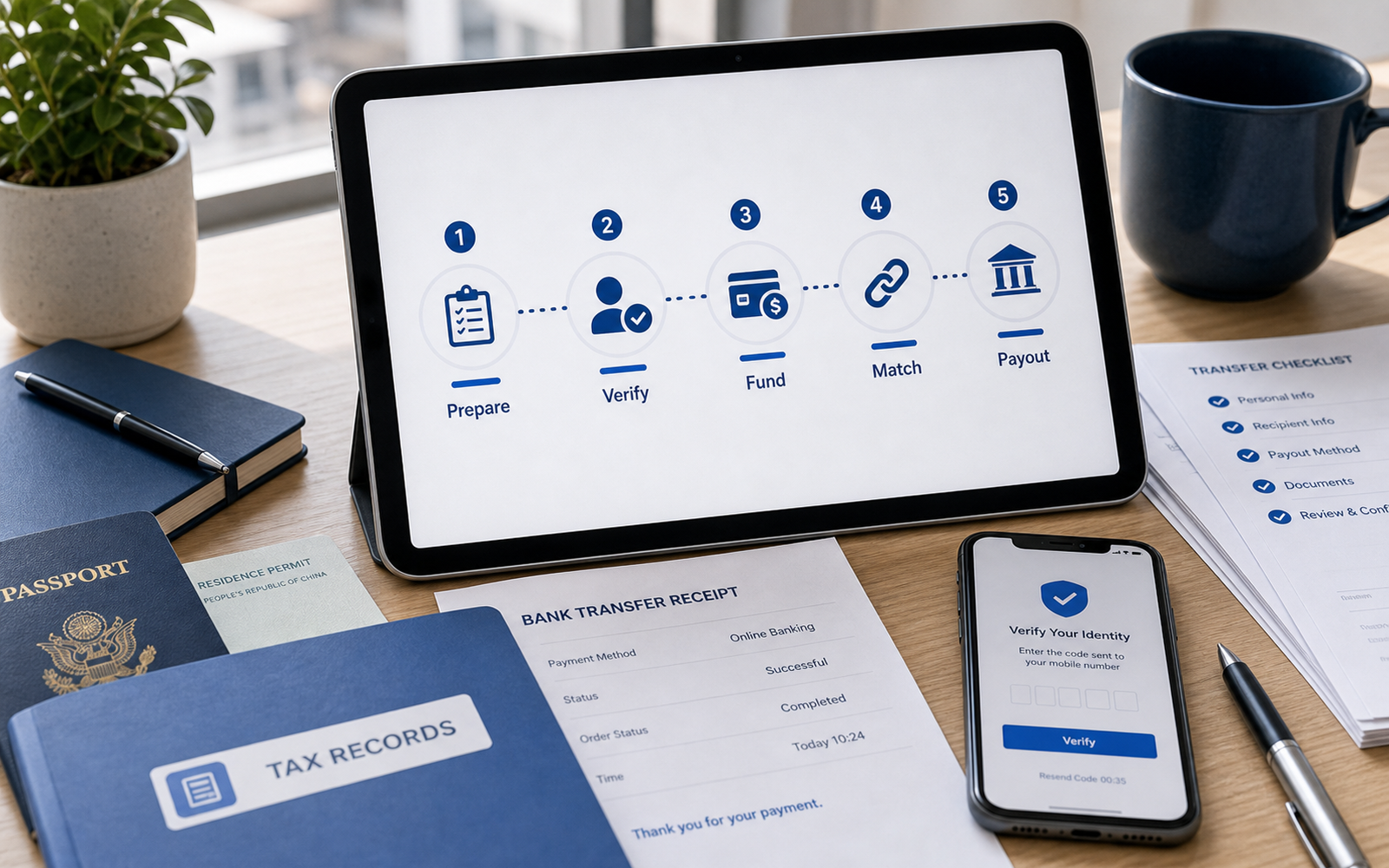
For a first-time expat in China, the reason a transfer feels difficult is usually not that the route is impossible — it is that the process involves several distinct stages that most users have not seen before: document preparation, online submission, review, RMB funding, rate confirmation, and overseas payout. Each of those stages usually has its own time range, its own potential delay point, and its own requirement before the next one can start.
This page covers the full sequence step by step, including how long each stage typically takes, what can cause delays at each point, and what a first-time user should realistically expect before their first transfer is complete.
Who This Process Is Usually For
- Expats in China making their first outbound transfer.
- Users with work-related status in China and tax or income support for a standard remittance case.
- Users who need to understand what happens first, what happens next, and where the first transfer most often gets delayed.
Who This Is Not Meant to Cover Fully
- Complex non-salary remittance cases.
- Users without standard work-related or accepted status support.
- Cases where the main issue is not first-transfer process but legal qualification or unusual source of funds.
What First-Time Users Need to Understand Before Starting
| What to know | Why it matters |
| Verification happens before payout | The first transfer cannot move smoothly if the user thinks registration alone means approval. |
| Recipient setup is separate from verification | Correct overseas account details are needed before payout can move cleanly. |
| RMB funding is its own step | Creating an order does not mean the transfer is funded yet. |
| Exchange-rate confirmation is its own action | Funding does not automatically mean payout has been released. |
| Arrival time starts after release | Users often underestimate how much of the transfer happens before payout timing really begins. |
The First-Transfer Sequence Most Expats Need to Follow
Step 1, Register and complete the basic account setup
Registration usually takes about 1 minute. This only creates the account. It does not mean the remittance is already approved.
Step 2, Submit identity, status, and income documents for verification
This is the real gate for a first transfer. For a standard expat salary-remittance case, the review usually focuses on identity, work-status fit, and whether the source of funds is supported clearly enough for the requested amount.
In normal cases, verification is usually completed within 1 working day, and clean files may be processed in as fast as about 2 hours. If the tax support is weak, the files are blurry, or the status does not fit a standard path, review may take longer or require corrections.
Step 3, Create the order and add the overseas recipient account
After verification is completed, you can create the order and enter the recipient details. This is one of the most common first-time error points because overseas beneficiary fields are not always identical across destinations.
Depending on the corridor, you may need not only the recipient name and account number, but also a SWIFT code, routing number, sort code, transit number, institution number, or another local bank field.
Step 4, Send RMB to the safeguarding account
Once the order is created, the transfer still needs to be funded. For first-time users, this is where many people first realize that review and funding are not the same thing.
Funding can usually be completed through supported methods such as bank transfer, Alipay, or WeChat Pay. Bank transfer usually avoids extra channel fees, while Alipay and WeChat Pay may add a channel fee and may also be more limited on larger payments.
In standard funding logic, a single wallet payment is commonly capped around 50,000 RMB, which is one reason bank transfer is often the cleaner option for larger first transfers.
Step 5, Confirm the exchange rate before payout is released
Exchange-rate confirmation is a separate step. A first-time user often assumes that once RMB is sent, the money is already on the way overseas. In reality, payout is released only after the rate is confirmed, either manually or through the available auto-confirmation setting.
For standard pricing logic, SkyRemit uses a 79 RMB fixed fee as the core pricing anchor, while the final amount received can still vary by currency pair, payout route, and intermediary-bank conditions in some wire-style cases.
Step 6, Wait for overseas payout and keep the receipt
After the rate is confirmed and the transfer is released, the remaining step is to wait for payout. Orders can be submitted 24/7, including during mainland holidays, but actual arrival time still depends on the route, receiving bank, timezone, holidays, and payment-rail conditions.
| Timing point | What it usually means |
| Fast supported corridors | Some transfers can arrive as fast as about 5 minutes in supported cases. |
| Typical payout window | Many transfers typically arrive within 24-48 hours after rate confirmation. |
Where First-Time Users Usually Get Stuck
- They assume registration means approval.
- They upload weak, blurry, or incomplete status and tax documents.
- They enter recipient-bank details incorrectly.
- They forget that RMB must still be sent to the safeguarding account.
- They miss the exchange-rate confirmation step.
- They misunderstand payout timing because release happens later than they expect.
What Makes the First Transfer Feel Slower Than Later Ones
The first transfer usually feels slower because the document path is being established for the first time, recipient details are more likely to need correction, and the user is learning the sequence at the same time. Once the first case is set up properly, later transfers are usually shorter and do not normally require full verification again for every order.
If the supported amount is later used up, a newer tax record is usually needed before more amount can be assessed.
First Transfer Trial Credit
If your case fits a documented salary-remittance route, a smaller first transfer can help you understand the process before sending a larger amount. New SkyRemit users can claim a 100 RMB trial credit and use the code TRY100 during registration.
Claim the trial credit and register
The trial credit is intended for first-time experience. Availability, eligibility, validity period, and detailed use rules are subject to the registration page and SkyRemit's current terms.
FAQ
Can I send money on the same day I register?
Sometimes yes, if the case is eligible, documents are ready, review moves quickly, and funding happens in time. For first-time users, verification is usually the biggest timing variable.
Do I only need a passport for the first transfer?
Usually no. For a standard work-related salary-remittance case, you also normally need a valid work-status document and tax or income support.
What usually causes the first transfer to fail or pause?
The most common reasons are missing tax support, unclear files, status mismatch, weak income proof for the requested amount, or incorrect recipient details.
Do I usually need to repeat the full verification after the first transfer?
Usually no. Later transfers are usually shorter once the first document path has been established, although a newer tax record may be needed when the supported amount is used up.
How fast can the money arrive after rate confirmation?
Some supported corridors can arrive as fast as about 5 minutes, while many transfers typically arrive within 24-48 hours after rate confirmation. Actual arrival time still depends on corridor, receiving bank, timezone, holidays, and payment-rail conditions.
Related Guides
If you want to understand the standard salary-remittance path, see how foreign workers send salary home from China. If you want the document checklist, see what documents foreigners need to send money from China. If you want to compare route types, see bank wire vs transfer platform in China. If you want to compare transfer speed, see the fastest way to send money from China. If you want to understand timing expectations, see how long does it take to send money from China. If you want the urgent version of this question, see send money abroad from China today.
The Bottom Line
For a first-time expat in China, the transfer usually becomes manageable once the order of steps is clear. Register first, complete verification, create the order, fund it, confirm the rate, and then wait for payout. That sequence is what makes the first transfer feel structured instead of confusing.