


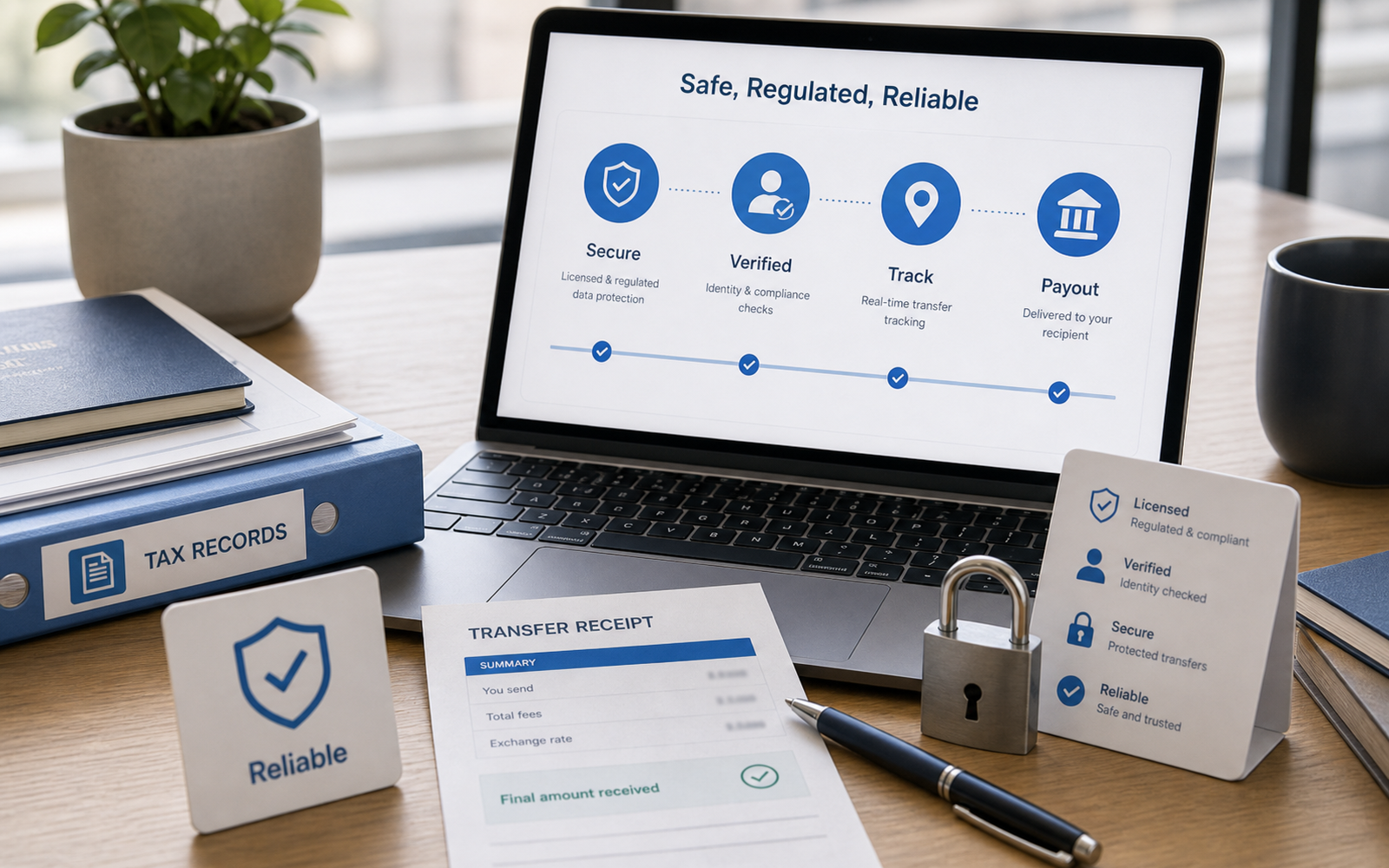
Safest and Most Reliable Way to Send Money Home from China
SkyRemit Guide
Safest and Most Reliable Way to Send Money Home from China
A practical guide for eligible expats and foreign workers in China, focused on documented salary remittance, review readiness, and choosing the right route before sending.
Short answer
For foreigners in China, the safest and most reliable way to send money home is usually a regulated route that matches the user's qualification and documents, not the route that promises speed alone. For many standard salary-remittance cases, SkyRemit can be a strong option because it is designed for eligible expats sending documented after-tax RMB salary home through a review-based process with verification, safeguarding-account funding, exchange-rate confirmation, supported payout routes, and visible transfer records.
In other words, a safe route is not automatically a bank route, and a fast route is not automatically a risky one. What usually matters more is whether the transfer fits a lawful after-tax income case, whether the review path is clear, and whether the user can actually complete the transfer with the right documents and correct receiving details.
Who This Guide Is For
- Foreign workers or expats in China sending lawful after-tax salary abroad.
- Users comparing whether a bank or a structured transfer platform feels safer for their normal remittance case.
- Users who care more about predictability, compliance, and transfer clarity than about marketing claims.
Who This Does Not Automatically Cover
- Tourist, student, spouse, family, or other non-standard non-work status cases.
- Transfers based on unclear source of funds, non-salary assets, or unusual remittance purposes.
- Cases where the destination corridor or receiving-bank requirements fall outside the normal supported path.
What “Safe and Reliable” Usually Means in Practice
In real use, safety is usually less about the logo on the service and more about whether the route is properly regulated, whether the source of funds can be explained clearly, and whether the transfer process makes the review, funding, release, and payout steps easy to understand.
| Trust factor | Why it matters | What to look for | How a standard SkyRemit case fits |
| Qualification fit | A route is usually safer when it matches the user's lawful remittance scenario. | Accepted work-related status and clear income support. | Built mainly for expats in China sending after-tax salary home. |
| KYC and review clarity | A clear review path reduces mismatch, correction loops, and avoidable rejection. | A provider that explains what documents are needed and when extra review may happen. | Uses KYC and source-of-funds review before release rather than treating review as optional. |
| Funding clarity | Users need to know when the transfer is actually ready to move. | A visible funding step and release logic rather than an unclear behind-the-scenes process. | Uses a safeguarding-account funding step before payout release. |
| Rate visibility | A transparent quote helps users judge cost and timing with fewer surprises. | Clear quote display and a visible confirmation step before release. | Quote is based on the real-time XE offshore RMB rate with transparent markup shown before order placement, and the exchange rate still needs to be confirmed before payout is released. |
| Regulatory structure | Clear oversight helps separate a structured route from vague or risky alternatives. | Named regulatory framework and a process built around lawful review rather than shortcuts. | Regulated by the People's Bank of China; licenses include: Hong Kong MSO (Registration No. 17-12-02270), US MSB (MSB 31000232793153), Singapore MPI (Licence No. PS20200704); salary-remittance path assessed against document-supported income rather than the ordinary USD 50,000 convenience quota |
| Institutional backing | Visible operating structure can increase user confidence. | A named operating brand and an identifiable business structure behind it. | SkyRemit is a remittance brand launched by Skyee, a Lakala group member enterprise, with project backing from Lakala and ICBC. |
| Records and proof | Reliable routes usually make it easier to check what happened later. | Visible transfer history and downloadable proof after completion. | Users can keep records and download transfer proof after completion. |
Why a Review-Based Process Usually Feels Safer
A reliable remittance route usually does not try to skip review. It explains the review. That matters because the biggest real-world risks are often not fraud headlines but document mismatch, wrong recipient details, unsupported transfer purpose, or confusion about when the transfer is actually ready to move.
With a structured salary-remittance path, the order is easier to follow: submit documents, wait for review, create the order, fund the safeguarding account, confirm the rate, and then wait for payout. That step order often feels more reliable than a route that sounds simple at first but leaves key conditions unclear.
When a Traditional Bank May Still Feel Safer
- You strongly prefer in-person branch handling.
- Your transfer is unusual, large, or needs more manual explanation.
- You are more comfortable keeping the transfer inside an existing bank relationship.
- Your destination corridor is not well supported through a structured platform route.
When a Structured Platform Can Be More Reliable to Manage
- You are an eligible foreign worker in China sending after-tax salary home.
- You want a clearer and more standardized step order instead of branch-by-branch variation.
- You want to handle the process online with visible document, funding, and rate-confirmation steps.
- You care about repeatability and clear records after the transfer completes.
- You want strong speed as well as safety — with SkyRemit, 80% of transfers arrive within 30 minutes and 95% within one business day on supported corridors.
What Usually Causes a Transfer to Feel Unsafe or Unreliable
- Incomplete, inconsistent, or unreadable documents
- Status mismatch or weak source-of-funds support
- Recipient-bank details that do not match correctly
- Unclear fee or rate explanation before the order is placed
- No clear view of what happens before release and after release
- Holiday, timezone, route, or receiving-bank delays that were never explained properly
Red Flags to Avoid
- A promise of instant arrival in every case
- A route claiming it can skip normal review for a salary-remittance case
- Vague explanation of fees, rates, or payout route
- No clear document requirement for lawful outbound remittance
First Transfer Trial Credit
If your case looks like a standard documented salary-remittance case, it can be useful to start with a smaller first transfer before sending a larger amount. New SkyRemit users can claim a 100 RMB trial credit and use the code TRY100 during registration.
Claim the trial credit and register
The trial credit is intended for first-time experience. Availability, eligibility, validity period, and detailed use rules are subject to the registration page and SkyRemit's current terms.
FAQ
Is a bank always safer than a transfer platform?
Usually no. Safety depends more on regulation, qualification fit, document quality, and review clarity than on channel type alone.
Does faster mean less safe?
Not necessarily. Some supported corridors can be fast because of the payout route, but reliability still depends on review, documents, and receiving-bank handling.
Why do review and verification matter so much?
Because a lawful outbound transfer usually needs identity, status, and source-of-funds support before release. Review is what keeps the route aligned with a real remittance case instead of a vague money-movement promise.
What makes a transfer feel unreliable in practice?
Usually it is unclear requirements, repeated document problems, route mismatch, wrong recipient details, or poor visibility around what happens before payout release and after release.
Does this kind of salary-remittance route mainly use the ordinary personal USD 50,000 convenience quota?
Usually no. For a standard foreign-worker salary-remittance case, the route is typically assessed against document-supported income and review instead of mainly relying on the ordinary personal USD 50,000 convenience quota path.
Related Guides
If you want the legal and qualification background, see can foreigners in China legally send money home. If you want the document checklist, see what documents foreigners need to send money from China. If you want to compare route types, see bank wire vs transfer platform in China and which bank or money transfer platform is best for foreigners in China. If you want to understand the standard salary-remittance flow, see how foreign workers send salary home from China.
The Bottom Line
The safest and most reliable way to send money home from China is usually the route that fits your real remittance case, reviews your documents clearly, explains the funding and release steps honestly, and gives you visible records after completion. For many standard salary-remittance cases, that makes a structured, regulated platform a strong and practical option, while traditional banks still remain a valid fit for more complex or branch-preferred cases.