


How to Fund Your Transfer from China: Bank Transfer, Alipay, or WeChat Pay
SkyRemit Guide
How to Fund Your Transfer from China: Bank Transfer, Alipay, or WeChat Pay
A practical guide for eligible expats and foreign workers in China, focused on documented salary remittance, review readiness, and choosing the right route before sending.
Short answer
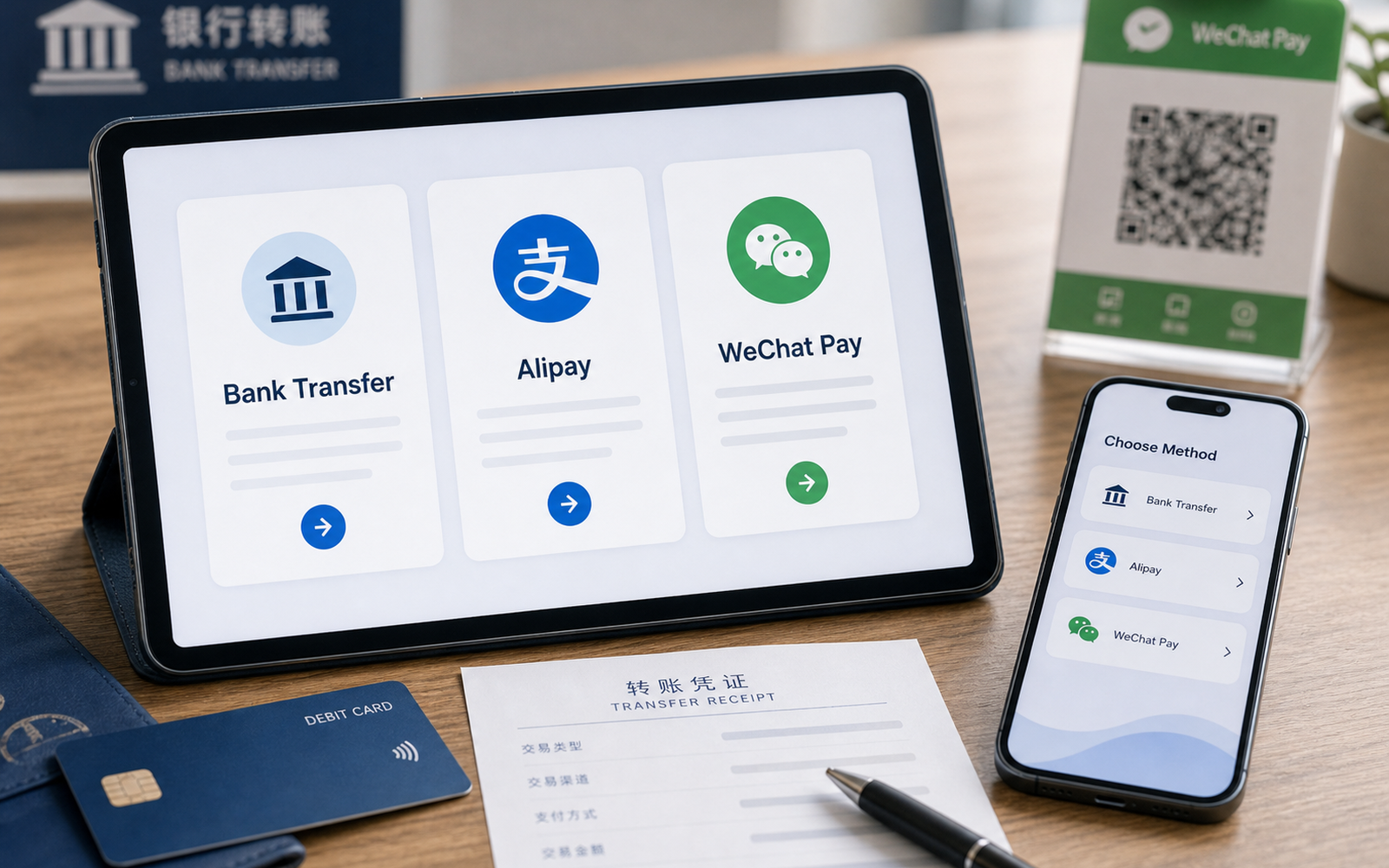
After verification, a standard salary-remittance order still needs to be funded before anything can move overseas. In most supported cases, the sender funds the order by sending RMB to the safeguarding account through bank transfer, Alipay, or WeChat Pay, then confirms the exchange rate before payout is released.
This page is only about the funding step. It is not a full first-transfer process article and not a broad qualification guide. The focus here is how the payment methods differ, how the cost logic changes, and what still needs to happen after the RMB has already been sent.
Quick Answer
- Bank transfer is usually the cleaner funding path because it often does not add the wallet channel fee.
- Alipay and WeChat Pay are more convenient but may add a channel fee and limit larger funding steps.
- Funding alone does not release the payout — the exchange rate still needs to be confirmed first.
The Standard Funding Flow
- Finish verification.
- Create the order with amount, currency, and recipient details.
- Send RMB to the safeguarding account through a supported payment method.
- Confirm the exchange rate.
- Wait for payout release and overseas arrival.
The funding step sits in the middle of the transfer. It is not the first stage, and it is not the final arrival stage either. For the full process, see first-time transfer from China full process.
Who This Funding Guide Usually Helps
This page is mainly for foreigners or expats in China who have already passed verification or are about to fund a standard salary-remittance order.
- Usually a strong fit: users choosing between bank transfer, Alipay, and WeChat Pay for the RMB funding step.
- Not the main purpose of this page: full first-transfer teaching or broad qualification questions.
Bank Transfer vs Alipay vs WeChat Pay
| Payment method | What users usually like | What to watch |
| Bank transfer | Often the cleaner funding path because it usually does not add the wallet channel fee. | The sender still needs to follow the payment details carefully. |
| Alipay | Familiar and convenient for users who already manage daily payments there. | A channel fee may apply, and larger funding steps can be more limited. |
| WeChat Pay | Convenient for users who want a mobile-first payment flow. | A channel fee may apply, and larger funding steps can be more limited. |
If the goal is to keep the funding-side cost structure simpler, bank transfer is often the first option users compare. If the goal is convenience and a familiar mobile payment experience, wallet-based methods can still feel easier.
How Cost Usually Shows Up
The easiest mistake is to compare only the fixed fee. In a standard pricing view, the funding-side cost usually combines the 79 RMB fixed fee, the quoted exchange rate based on the real-time XE offshore RMB rate with visible markup, any channel fee that may apply for Alipay or WeChat Pay, and possible downstream wire-related costs in some routes.
That is why the final amount received matters more than the fixed fee alone. For the full cost logic, see the cheapest way to send money from China overseas.
What Usually Matters on Larger Funding Steps
In standard funding logic, wallet-based methods can be more limited on larger payments. A single wallet payment is commonly capped around 50,000 RMB, which is one reason bank transfer is often the cleaner option for bigger funding steps.
For more on limits, see transfer limits for foreigners sending money from China.
What Happens After You Fund the Order
Sending the RMB does not automatically release the payout. The exchange rate still needs to be confirmed before the overseas side moves forward.
In the standard flow, that confirmation happens after the money reaches the safeguarding account. Some users confirm right away. Others may wait within the available confirmation window depending on the order setup.
For expected timing after release, see how long does it take to send money from China.
Common Mistakes During Funding
- Sending money before the order details are fully correct.
- Using a payment method without noticing the cost difference.
- Assuming the transfer is already on the way before rate confirmation.
- Forgetting that overseas arrival still depends on route, receiving-bank handling, timezone, and holidays after release.
Which Funding Method Often Fits Best
Bank transfer is often the better fit when the sender wants the cleaner cost path and is comfortable following account details carefully. Alipay or WeChat Pay can be a strong fit when convenience matters more and the sender prefers a familiar mobile payment flow.
Ready to Test the Flow?
Once your documents and recipient details are organized, a smaller first transfer can help you understand how review, funding, and payout work before sending a larger amount. New SkyRemit users can claim a 100 RMB trial credit and use the code TRY100 during registration.
Claim the trial credit and register
The trial credit is intended for first-time experience. Availability, eligibility, validity period, and detailed use rules are subject to the registration page and SkyRemit's current terms.
FAQ
Do I need to go to a bank branch to fund the transfer?
Usually no. The standard flow is designed to be handled online through supported payment methods after verification and order creation.
Does Alipay or WeChat Pay change the total cost?
Usually it can. Wallet-based payment methods may add a channel fee, while bank transfer usually does not.
Is the transfer released as soon as the RMB is paid?
Not yet. The exchange rate still needs to be confirmed before payout is released.
Is the fixed fee the whole cost?
Usually not. The final recipient amount can also be affected by FX markup, payment method, and some route-specific downstream costs.
Which option is usually more cost-efficient?
Bank transfer is often the cleaner funding option from a cost perspective, but the best comparison is still the final amount the recipient receives.
Related Guides
If you want to compare bank wire and transfer platform, see bank wire vs transfer platform in China. If you want to understand the full salary-remittance process, see how foreign workers send salary home from China. If you want to understand verification, see getting verified for salary remittance from China. If you want to compare transfer speed, see the fastest way to send money from China.
The Bottom Line
Funding is the point where a salary-remittance order becomes operational. It is also where many users first notice the difference between convenience and total cost. When the sender understands the payment-method options, cost logic, and exchange-rate confirmation step clearly, the rest of the transfer usually feels much easier to manage.